Leak Fix London Packages Leak Detection, Repair and Reinstatement Into One Job as Data Shows 16 in 25 Faults Are Not Pipes
Just another WordPress site
Press Release Disclaimer: This is a press release distributed through the XPR Media network. It has not been independently verified by our newsroom.
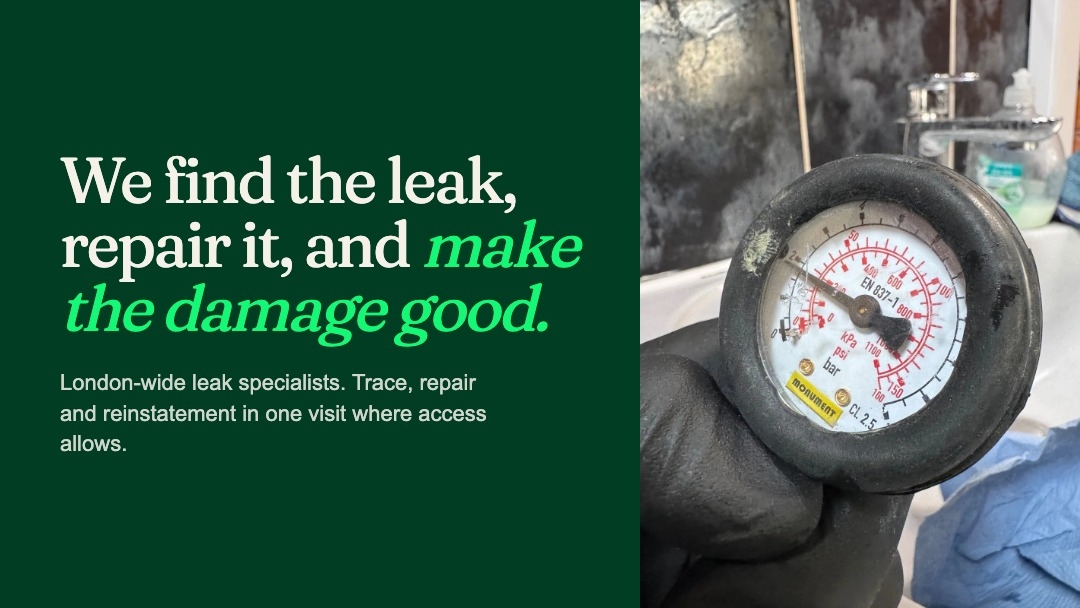

London, United Kingdom – October 7, 2026 – Leak Fix London, a leak detection and repair firm covering all 32 London boroughs, has published an analysis of 25 leak investigations it documented in full between 17 July and 18 September 2026, drawn from 149 job records. The analysis sets out the method used on each job and the outcome it produced, and it is published in full on the company’s website.
The headline finding runs against the assumption most households arrive with. In 16 of the 25 investigations, the fault was not a failed pipe. Six were fittings, valves or sanitaryware, five properties had no plumbing leak at all, two were waste or drainage faults, one was a boiler component, one was tile grout, and one was never established. Nine were genuine failures of pressurised pipework, and six of those nine were under a floor or underground.
“A leak is a diagnosis before it is a repair, and the diagnosis is wrong more often than people expect,” said Val Neagu, Director at Leak Fix London. “Fifteen of the twenty-five customers arrived with a theory about where the water was coming from. The investigation contradicted ten of them. Of the five who were right, three were right only about the room. That is the number that should decide whether you let anyone lift a floor on a hunch.”
One package instead of three companies
The company’s central proposition is that a leak is one job, not three. Most London leak specialists trace the leak, issue a report and stop there, leaving the homeowner to find a plumber for the repair and a builder for the floor, plaster or ceiling that was opened to reach it. Leak Fix London carries out all three stages with its own engineers, plumbers and builders: the tracing, the pipework repair or replacement, and the reinstatement of screed, flooring, plaster, ceilings, tiling and decoration.
“That is why the name is Leak Fix London rather than Leak Detection London,” said Neagu. “The fix is the half of the job that usually gets handed to somebody else. Three companies means three appointments, three invoices and three chances for each of them to say the problem belongs to one of the others. When one firm traces it, repairs it and puts the room back, there is nobody left to blame.”
The firm was formed by plumbers who have worked in London for fifteen years, most of that time as sole traders. The all-in-one package exists because of what that work exposed: a sole-trader plumber repairs the pipe, then watches the customer chase a builder for the floor and a decorator for the ceiling, and hears from them weeks later when the trades have not agreed.
Which detection methods actually located the leak
The company has also published the per-method outcome, which is rarely made public in the trade. Across the 25 investigations, plain visual inspection settled eight cases. Tracer gas located the leak in four of the eight jobs where it was used. An inspection camera pinpointed one of four. Thermal imaging located none in the two jobs where its use was recorded. Pressure testing located nothing on its own across 11 uses, and was still the decisive step, because four of those tests produced a clear negative that ruled out a whole circuit.
“Ruling a circuit out is worth as much as finding the leak, and it is the part nobody sells,” said Neagu. “A negative pressure test is what stops somebody opening the wrong ceiling. We publish the hit rates because a homeowner comparing two firms has no other way to judge whether the equipment on the van is the equipment their job needs.”
What the work costs, and what insurance pays for
Detection is charged at £150 per hour, agreed before attendance. The rate does not rise for a difficult property, an awkward access, an evening or a weekend. On a house, a multi-bathroom property or any job that can be scoped in advance, the company will quote a fixed price for the detection instead of charging by the hour, so the total is known before anyone attends. Detection is offered on a no find, no fee basis: if a live leak inside the property cannot be located, the time spent looking is not charged.
The company’s own job records give the scale. Across 152 priced jobs, the median detection job is £390 and the largest is £1,280, while the largest repair-and-reinstatement job in the set is £3,600.
Those figures matter against how trace and access cover works. Most UK buildings policies pay to find a leak and to open up and make good the structure to reach it, but not to repair the leaking pipe itself. Published limits vary: Admiral states £5,000, rising to £10,000 on Platinum; Allianz states £5,000 on Bronze and Silver and £10,000 on Gold; Saga states up to £5,000 on Select. The Association of British Insurers notes the cover is not always offered as standard, and it is generally absent from contents-only policies.
“On the numbers in our own records, a £5,000 trace and access limit covers the detection and the making good on effectively every domestic job we see,” said Neagu. “What it will not cover is the new pipe, and people are regularly told otherwise. A report that separates detection, access, repair and reinstatement into their own lines is what gets the covered part paid without an argument, and that is why ours is standard rather than an extra.”
Every job is documented in a written report setting out the acoustic, thermal, moisture and pressure test results, photographing the located defect, and itemising the four stages separately. A guide to how escape of water and trace and access claims are assessed is published at https://leakfixlondon.co.uk/insurance-claims/ and current rates at https://leakfixlondon.co.uk/pricing/
Regulation behind the reinstatement work
The reinstatement side is shaped by a water regulation widely broken in London housing stock. Schedule 2, paragraph 7 of the Water Supply (Water Fittings) Regulations 1999 provides that no water fitting shall be embedded in any wall or solid floor, and that no fitting consisting of a joint shall be a concealed water fitting. Much of the push-fit pipework buried in screed in London flats is non-compliant on that basis, and a repair that reinstates the same detail simply schedules the next leak.
The full dataset is published at https://leakfixlondon.co.uk/blog/what-25-london-leak-investigations-found/ and the reinstatement service at https://leakfixlondon.co.uk/services/leak-damage-repair-and-reinstatement/
About Leak Fix London
Leak Fix London is a leak detection, pipework repair and reinstatement company serving all 32 London boroughs and the surrounding M25 area. It was formed by plumbers who have worked in London for fifteen years, most of that time as sole traders, and who brought detection, plumbing and building work under one name so that a domestic leak is a single job with a single firm accountable for it. The company traces hidden leaks using acoustic, thermal imaging, moisture mapping, pressure testing and hydrogen-nitrogen tracer gas methods, carries out the pipework repair, and reinstates the floors, walls and ceilings opened to reach it. Work is priced at a published hourly rate or a fixed quotation, and documented to a standard an insurer will accept.
Media Contact
Company Name: Leak Fix London
Contact Person: Charles Briggs
Email: Send Email
Phone: 020 3995 0888
Address:71-75 Shelton Street Covent Garden
City: London
State: Greater London, WC2H 9JQ
Country: United Kingdom
Website: https://leakfixlondon.co.uk
Press Release Distributed by ABNewswire.com
To view the original version on ABNewswire visit: Leak Fix London Packages Leak Detection, Repair and Reinstatement Into One Job as Data Shows 16 in 25 Faults Are Not Pipes